Skip to product information
1 of 5

SAATI Vertical LTS Direct Laser Imaging & Exposure Systems

SAATI Vertical LTS Direct Laser Imaging & Exposure Systems

Saati

SKU:

×

Got a question about SAATI Vertical LTS Direct Laser Imaging & Exposure Systems?

Payment & Security

Payment Methods Accepted

Your payment information is processed securely. We do not store credit card details nor have access to your credit card information.

Shipping, Crating, and Packaging Fees

Additional Shipping & Crating Fees

Lawson made equipment comes with a Shipping and Crating Charge that is not included in the price shown and will not be reflected in your order's total. We will contact you after order completion with a final cost.

Download Product's PDF Brochure

Financing Options

Need to finance the SAATI Vertical LTS Direct Laser Imaging & Exposure Systems? No problem! Visit our Financing Page for more details.

Got a question about this product?

View full details

Description

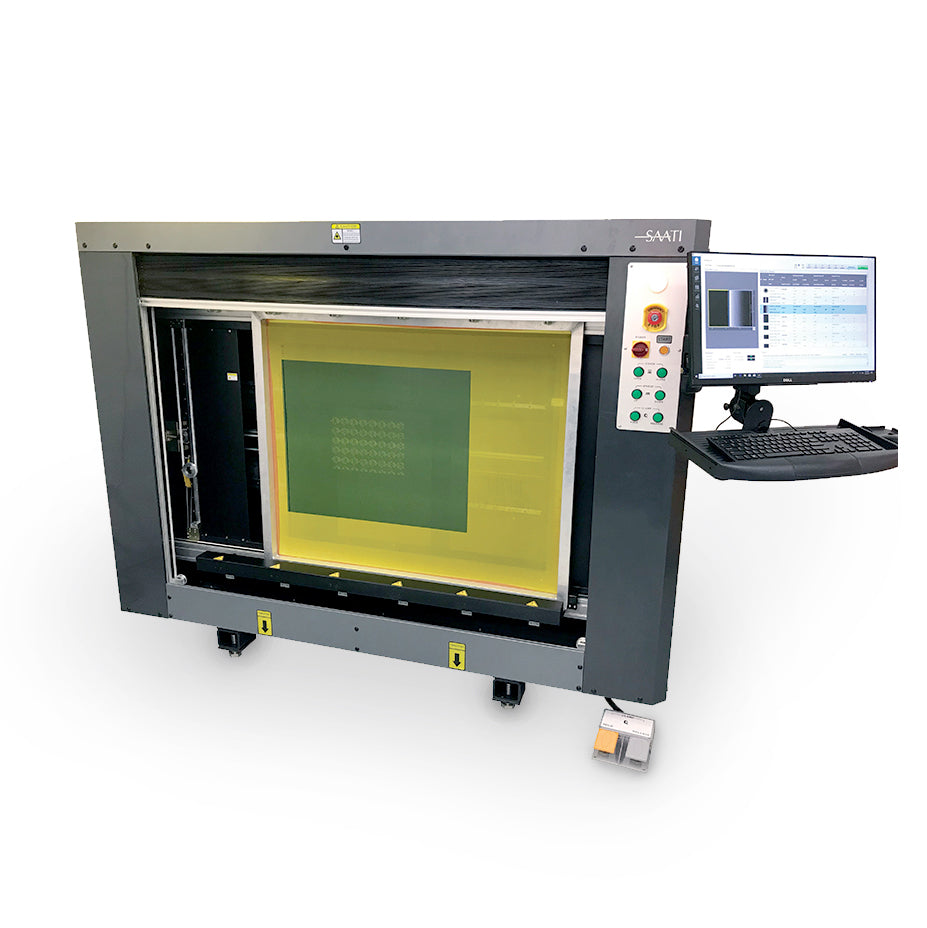
SAATI Vertical LTS systems combine direct laser computer-to-screen imaging and exposure in one self-contained machine. Their vertical, glassless design incorporates a safety shutter and processes coated screens without vacuum draw-down or film positives.

Choose from four configurations:

  • SAATI LTS 6012 — First Generation.
  • SAATI LTS 8012 — First Generation.
  • SAATI LTS 1015 — First Generation.
  • SAATI LTS 8012 HD — Second Generation.

The range offers maximum image areas from 600 × 1200 mm to 1000 × 1500 mm, with single-frame and dual-frame loading options. Each model provides selectable resolutions of 847, 1270, and 2540 DPI, allowing the imaging setup to be matched to the artwork and stencil requirements.

All four systems are PC-operated and use 1-bit TIFF files, with optional RIP software. Artwork originating from PC or Mac design applications can be prepared through a compatible file-output workflow.

The second-generation LTS 8012 HD adds dedicated individual frame clamping, digitally adjustable and programmable upper and lower frame-holder rails, and upgraded encoder, drive, and mechanical systems. These improvements support frame handling and precise pixel placement while retaining an 800 × 1200 mm maximum image area.

Direct laser imaging eliminates film positives and masking ink or wax from the imaging stage. Emulsion or stencil film, screen preparation, development, and other required finishing steps remain part of the complete screen-making process.

The LWG Difference

  • Model Selection: Compare four configurations around your artwork, frame sizes, and production needs.
  • Workflow & Installation Planning: Review software, screen-room layout, utilities, and delivery requirements before installation.
  • Training & Support: Confirm available setup assistance, operator training, service arrangements, and warranty coverage with LWG.

Features

  • Integrated Imaging & Exposure: Direct laser screen imaging without film positives or vacuum draw-down.
  • Vertical, Glassless Design: Enclosed operation with a safety shutter.
  • Three Resolution Options: Select 847, 1270, or 2540 DPI.
  • Single- or Dual-Frame Loading: Process one large frame or two compatible smaller frames, depending on the model.
  • Digital File Workflow: PC-operated with 1-bit TIFF files and optional RIP software.
  • Second-Generation HD Upgrades: The 8012 HD adds individual clamps, programmable frame-holder rails, and upgraded motion systems.

Media & Videos

Specifications Table

Specification | LTS 6012 — 1st Gen | LTS 8012 — 1st Gen | LTS 1015 — 1st Gen | LTS 8012 HD — 2nd Gen
System Type | Direct laser imaging and exposure | Direct laser imaging and exposure | Direct laser imaging and exposure | Direct laser imaging and exposure
Design | Vertical, glassless | Vertical, glassless | Vertical, glassless | Vertical, glassless
Safety Shutter | Included | Included | Included | Included
Laser Array | 96 lasers | 128 lasers | 160 lasers | 128 lasers
Resolution Options | 847 / 1270 / 2540 DPI | 847 / 1270 / 2540 DPI | 847 / 1270 / 2540 DPI | 847 / 1270 / 2540 DPI
Maximum Image Size | 600 × 1200 mm | 800 × 1200 mm | 1000 × 1500 mm | 800 × 1200 mm
Image Size, Inches | 23.6 × 47.2 in | 31.4 × 47.2 in | 39.3 × 59 in | 31.4 × 47 in
Maximum Single Frame | 1100 × 1700 mm | 1100 × 1700 mm | 1350 × 2000 mm | 1160 × 1700 mm
Single Frame, Inches | 43.3 × 66.9 in | 43.3 × 66.9 in | 53.1 × 78.7 in | 45.6 × 66.9 in
Dual-Frame Capacity | Two 584 × 787 mm frames | Two 635 × 915 mm frames | Two 635 × 915 mm frames | Two 635 × 915 mm frames
Dual Frames, Inches | Two 23 × 31 in frames | Two 25 × 36 in frames | Two 25 × 36 in frames | Two 25 × 36 in frames
Machine Dimensions | 2650 × 730 × 1690 mm | 2650 × 730 × 1690 mm | 2920 × 730 × 2050 mm | 2800 × 750 × 1900 mm
Dimensions, Inches | 104.3 × 28.7 × 66.5 in | 104.3 × 28.7 × 66.5 in | 114.9 × 28.7 × 80.7 in | 110.2 × 29.5 × 74.8 in
Monitor-Arm Allowance| Additional 23 in | Additional 23 in | Additional 23 in | Additional 23 in
Weight | 878 kg / 1935.6 lb | 878 kg / 1935.6 lb | 1376 kg / 3033.5 lb | 1240 kg / 2733.7 lb
Electrical Input | 110V or 220V | 110V or 220V | 110V or 220V | 110V or 220V
Compressed Air | Required | Required | Required | Required
Air Pressure | 90 PSI / 6.205 bar | 90 PSI / 6.205 bar | 90 PSI / 6.205 bar | 90 PSI / 6.205 bar
Air Consumption | Less than 1 CFM | Less than 1 CFM | Less than 1 CFM | Less than 1 CFM
Operation | PC-operated | PC-operated | PC-operated | PC-operated
File Format | 1-bit TIFF | 1-bit TIFF | 1-bit TIFF | 1-bit TIFF
RIP Software | Optional | Optional | Optional | Optional
Stencil Materials | Emulsions and stencil films | Emulsions and stencil films | Emulsions and stencil films | Emulsions and stencil films
Vacuum Draw-Down | Not required | Not required | Not required | Not required
Film Positives | Not required | Not required | Not required | Not required
Specified Laser Life | More than 10,000 hours | More than 10,000 hours | More than 10,000 hours | More than 10,000 hours
Warranty | One year | One year | One year | One year

Comparison Table

Comparison Point | LTS 6012 — 1st Gen | LTS 8012 — 1st Gen | LTS 1015 — 1st Gen | LTS 8012 HD — 2nd Gen
Main Distinction | Smallest image area among these four models | Wider image area than the LTS 6012 | Largest image area and single-frame capacity | Updated handling and motion systems
Maximum Image Area | 600 × 1200 mm | 800 × 1200 mm | 1000 × 1500 mm | 800 × 1200 mm
Maximum Single Frame | 1100 × 1700 mm | 1100 × 1700 mm | 1350 × 2000 mm | 1160 × 1700 mm
Two-Frame Setup | Two 584 × 787 mm frames | Two 635 × 915 mm frames | Two 635 × 915 mm frames | Two 635 × 915 mm frames
Laser Count | 96 | 128 | 160 | 128
Resolution Choices | 847 / 1270 / 2540 DPI | 847 / 1270 / 2540 DPI | 847 / 1270 / 2540 DPI | 847 / 1270 / 2540 DPI
Frame Handling | Pneumatic clamps | Pneumatic clamps | Pneumatic clamps and frame clamping | Dedicated individual
Frame-Holder Rails | Confirm adjustment arrangement | Confirm adjustment arrangement | Confirm adjustment arrangement | Digitally adjustable and programmable
Motion-System Focus | 1st-generation system | 1st-generation system | 1st-generation system and mechanical systems | Upgraded encoder, drive,
Machine Size, mm | 2650 × 730 × 1690 | 2650 × 730 × 1690 | 2920 × 730 × 2050 | 2800 × 750 × 1900
Machine Weight | 878 kg | 878 kg | 1376 kg | 1240 kg
Selection Priority | Smaller image area and 23 × 31 in dual frames | 800 × 1200 mm artwork and 25 × 36 dual frames | Larger artwork or larger single frames | HD handling upgrades with an 800 × 1200 area
Key Limitation | Smaller dual-frame and image-area capacity | Smaller image area than the LTS 1015| Larger machine and higher weight | Same image area as the 1st-generation 8012

Questions & Answers

Which models are covered on this page?

This page covers the SAATI LTS 6012 First Generation, LTS 8012 First Generation, LTS 1015 First Generation, and LTS 8012 HD Second Generation.

Do these systems combine imaging and exposure?

Yes. All four models combine direct laser computer-to-screen imaging and exposure in one self-contained system. They do not require film positives or vacuum draw-down.

What is the main difference between the LTS 6012, 8012, and 1015?

Their maximum image areas are 600 × 1200 mm, 800 × 1200 mm, and 1000 × 1500 mm respectively. They also differ in laser count, frame capacity, dimensions, and weight.

How is the second-generation LTS 8012 HD different from the first-generation LTS 8012?

The LTS 8012 HD adds dedicated individual frame clamping, digitally adjustable and programmable upper and lower frame-holder rails, and upgraded encoder, drive, and mechanical systems. Its maximum single-frame capacity increases to 1160 × 1700 mm, while the image area remains 800 × 1200 mm. Its dimensions and weight also differ.

Can all four models process two screens?

Yes, within their specified capacities. The LTS 6012 accommodates two frames up to 584 × 787 mm each. The other three models accommodate two frames up to 635 × 915 mm each. Confirm the actual loading arrangement and artwork placement.

Is maximum image size the same as maximum frame size?

No. Maximum image size describes the available imaging area. Maximum frame size describes the outer frame capacity. Check both against the artwork and frames you intend to use.

What resolutions are available?

All four models offer 847, 1270, and 2540 DPI. Select the setting appropriate to the artwork and stencil process.

Can I use artwork created on a Mac?

Yes, through a compatible file-preparation workflow. The machines are PC-operated and use 1-bit TIFF files, so Mac-originated artwork must be prepared in the required format.

Is RIP software included?

RIP software is optional in the supplied specifications. Confirm the selected software, license, computer requirements, compatibility, and included setup assistance before ordering.

Do these machines require compressed air?

Yes. All four models require compressed air for pneumatic clamps at 90 PSI, approximately 6.205 bar, with consumption below 1 CFM.

Does “no consumables” mean no screen-making supplies are needed?

No. Direct laser imaging removes film positives, masking ink, and wax from the imaging stage. Emulsion or stencil film and other supplies remain necessary for the complete screen-making process.

What electrical supply and installation space are required?

All four models list compatibility with 110V or 220V input. Dimensions and weight vary by model, and each requires an additional 23 inches for the adjustable monitor arm. Confirm the supplied electrical configuration and complete installation clearances before delivery.

What laser life and warranty are specified?

All four models specify more than 10,000 hours of laser life and a one-year warranty. Laser life is not the warranty duration; review the applicable coverage and maintenance requirements.