

Textile Start Up Supply Package
Textile Start Up Supply Package
Couldn't load pickup availability
Payment & Security

Your payment information is processed securely. We do not store credit card details nor have access to your credit card information.
- DESCRIPTION
- REVIEWS
Textile Start-Up Supply Package | Seriously Screen Print
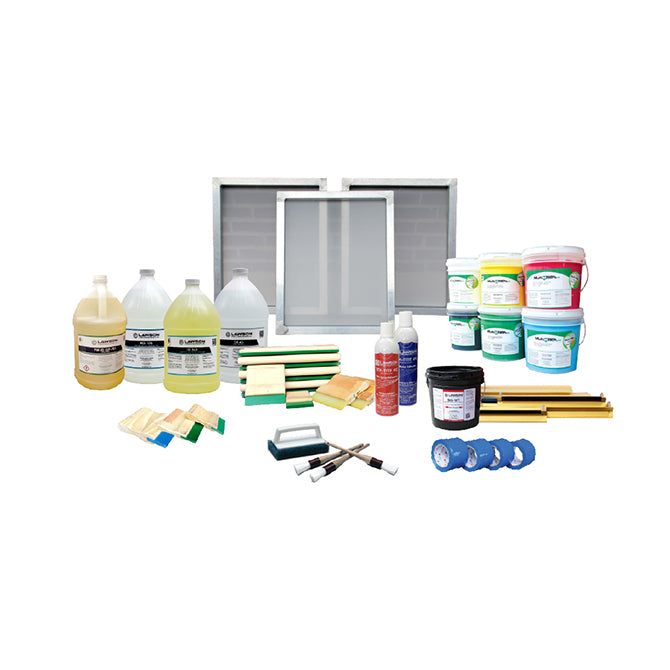
The Lawson Textile Start-Up Screen Printing Supply Package includes everything you need to start screen printing. It provides plastisol inks, squeegees, pre-press and production chemicals, tapes, aluminum frames, and other supplies for printing T-shirts, hoodies, and other textiles. This comprehensive screen printing supply kit is ideal for beginners and established print shops.
Lawson’s supplies for T-shirt and graphics screen printing include the following:
- DI-1550 Plus White - 1 Gallon
- DI-200 Black - 1 Gallon
- DI-5140 LB Rojo Red - 1 Quart
- DI-902 LB Light Gold - 1 Quart
- DI-400 LB Bright Orange - 1 Quart
- DI-704 Royal Blue - 1 Quart
- DI-808 Forest Green - 1 Quart
- DT Thinner/Reducer #4 - 1 Quart
- WOW-100/MSB-100 Clear - 1 Gallon
- Aluminum Screen Printing Frames with 110 Mesh - 3
- Aluminum Screen Printing Frames with 158 or 160 Mesh - 2
- Aluminum Screen Printing Frames with 180 Mesh - 1
- 4-inch Squeegee Cards for Cleanup - 5
- Flat Scrub Brushes - 3
- 15-inch Emulsion Coater - 1
- SBQ-501 Ultra-Fast Blue Emulsion - 1 Quart
- Tex-Tite #1 Adhesive Spray Can
- Tex-Tite #2 Adhesive Spray Can
- Tex-Tite #3 Adhesive Spray Can
- Clog-Buster Spray Can
- 14-inch Hand Squeegee with 70 Durometer - 6
- Pellons 14" x 16" Combo Pack for Test Printing
- Blue Blockout Tape - 2-inch x 36-yard roll
- Thermo-Tels #5 Temperature Strips - 2 packs
- SR-45 Stencil Remover for Reclaiming Screens - 1 Gallon
- PW-305 Universal Press Wash - 1 Gallon
- ID-360 Ink Degrader for Reclaiming - 1 Quart
- LSP Red-Coat Blockout for filling mesh not covered by emulsion - 1 Quart
- MD-100 Mesh Degreaser - 1 Gallon
- Hardwood Spatulas - 1 pack of 10
- Garment Printing Made Easy Booklet
Which Size Should You Choose?
Each package includes the same inks, chemicals, and emulsion. The only difference is the screen frame size: the Manual package includes 20" x 24" frames, the Semi-Auto package includes 20" x 28" frames, and the Auto package includes 23" x 31" frames.
Key Features:
- Comprehensive Kit: Includes plastisol inks, squeegees, chemicals, tapes, and aluminum frames for T-shirt and graphics printing.
- Versatile Supplies: Suitable for printing T-shirts, hoodies, and other textiles.
- Variety of Inks and Chemicals: Includes plastisol inks, thinner, stencil remover, ink degrader, and mesh degreaser.
- American-Made Quality: Built in the U.S.A. for durability and reliability in demanding print shop environments.
Note: Items shown in images are subject to change without notice. Some items are not shown.
Technical FAQ: Choosing the Right Screen Printing Mesh Count
What mesh count is best for printing glitter and shimmer inks?
Use a low mesh count between 24 and 86 for glitter and shimmer inks. Larger glitter flakes require very open meshes such as 24/25, 38/40, or 60/61 to allow particles to pass through without clogging. For finer shimmer inks or foil adhesives, an 85/86 mesh provides better control while still allowing adequate ink flow.
Why is 110 mesh commonly used in garment screen printing?
A 110 mesh count is widely used because it delivers a heavy ink deposit, making it ideal for bold graphics, block text, and high-viscosity plastisol inks. It is especially effective for white underbases, allowing printers to achieve strong opacity in a single pass and improve production efficiency.
What mesh count should I use for thick white plastisol ink?
A 125 mesh count is a strong choice for thick white plastisol inks. It balances ink flow and detail, offering slightly finer resolution than 110 mesh while still maintaining enough openness to prevent clogging or poor ink release.
What is the best all-purpose mesh count for t-shirt printing?
A 156/160 mesh count is considered the best general-purpose option for screen printing on garments. It works well with both plastisol and water-based inks, providing good detail retention while maintaining consistent ink coverage across most designs.
How can I achieve a soft-hand feel when printing with plastisol ink?
To create a softer print with plastisol ink, use a higher mesh count such as 196/200. This reduces the amount of ink deposited on the garment, resulting in a lighter, smoother feel. Keep in mind that higher mesh counts may reduce opacity, making this approach best for lighter fabrics or fashion prints.
What mesh count is ideal for halftones and fine detail printing?
A 230 mesh count is ideal for halftones, fine lines, and detailed artwork. It allows for precise stencil definition and clean ink transfer. For very fine detail or thinner inks, a 280 mesh count can further improve sharpness and control.
When should I use a 305 mesh screen for screen printing?
A 305 mesh count is best for ultra-fine detail, including small halftone dots, CMYK process printing, and simulated process designs. The higher thread count ensures accurate dot reproduction and prevents distortion, resulting in sharper, more professional prints.