


Ulano EZ-FILM Capillary Film
Ulano EZ-FILM Capillary Film
Couldn't load pickup availability
Payment & Security

Your payment information is processed securely. We do not store credit card details nor have access to your credit card information.


- DESCRIPTION
- REVIEWS
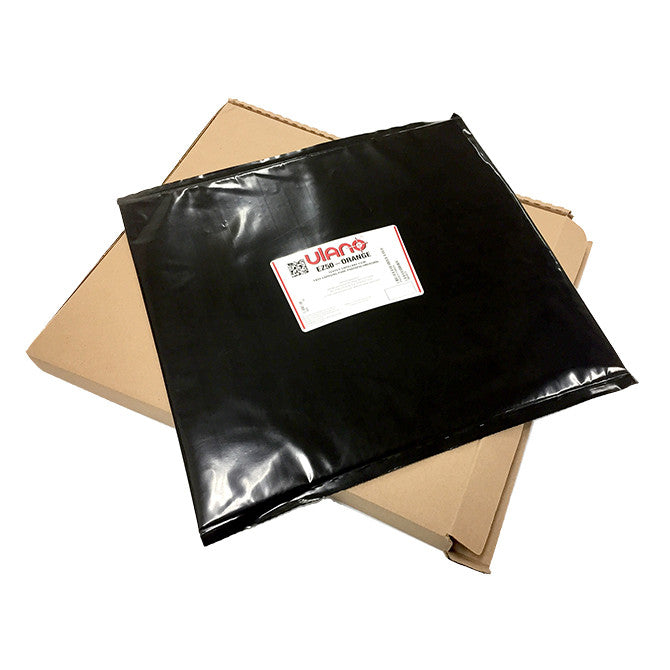
Ulano EZ-Film Capillary Film | Consistent, High-Quality Stencils
Ulano EZ-Film is a premium capillary emulsion film for T-shirt and garment printing, offering significant savings in labor and production time compared to liquid emulsion. Eliminate the need for scoop coaters or manual application by applying the pre-coated film to a wet screen for quick, mess-free stencil creation. With factory-controlled emulsion thickness, EZ-Film ensures consistent exposure times and uniform emulsion-over-mesh (EOM) thickness for predictable ink deposits with plastisol and water-based inks.
Benefits: Produces perfect stencils quickly and consistently, with no mess or waste. Consistent stencil thickness ensures high-quality prints and controlled ink deposits, making it ideal for shops seeking efficiency and precision.
Choosing the Right Thickness: EZ-Film is available in 50-micron and 30-micron thicknesses. Select based on mesh count, print run size, and desired ink deposit. Higher micron counts create thicker stencils, similar to applying multiple coats of liquid emulsion.
EZ-Film-50 (50 microns): Recommended for mesh counts of 86–196 threads per inch (33–77 threads/cm). Ideal for basic and athletic printing, this fast-exposing, pure photopolymer (SBQ) textile capillary film is coated on 300-gauge matte polyester. It can be adhered with plain water or direct emulsion in direct/indirect mode. Suitable for short-run water-based ink printing. Most popular.
EZ-Film-30 (30 microns): Ideal for mesh counts of 230–419 threads per inch (90–165 threads/cm). Designed for plastisol ink and non-aggressive solvent-based inks with mild wash-up solvents. Note: Screen openers and aggressive solvents may complicate reclamation. Thinner stencils deposit less ink.
Key Features:
- High-Contrast Orange Color: Reduces halation for improved resolution, allows use of cost-effective white mesh, and simplifies stencil inspection and see-through registration.
- Fast Processing and Exposure: Dries faster than liquid emulsion, supports rapid stencil turnaround, and reduces labor and production time.
- User-Friendly: Easier to apply than liquid emulsion, with wide processing and exposure latitude across various exposure units, ensuring perfect stencils every time.
- Pre-Coated Stencils: Provides consistent stencil thickness, controls ink deposit, and reduces labor in screen preparation.
- Wet Processing: Minimizes pinholes due to uniform emulsion application and speeds up production.
- Convenient Pre-Cut Sheets: Available in 15” x 17” (≈38 x 43 cm) and 17” x 24” (≈43 x 60.9 cm), packaged 50 per box.
Note: 17” x 24” sheets are sold in quantities of 4. Contact Lawson at 314-382-9300 to order.
Additional Information: Demonstration for Proper Application
Technical FAQ: Choosing the Right Screen Printing Mesh Count
What mesh count is best for printing glitter and shimmer inks?
Use a low mesh count between 24 and 86 for glitter and shimmer inks. Larger glitter flakes require very open meshes such as 24/25, 38/40, or 60/61 to allow particles to pass through without clogging. For finer shimmer inks or foil adhesives, an 85/86 mesh provides better control while still allowing adequate ink flow.
Why is 110 mesh commonly used in garment screen printing?
A 110 mesh count is widely used because it delivers a heavy ink deposit, making it ideal for bold graphics, block text, and high-viscosity plastisol inks. It is especially effective for white underbases, allowing printers to achieve strong opacity in a single pass and improve production efficiency.
What mesh count should I use for thick white plastisol ink?
A 125 mesh count is a strong choice for thick white plastisol inks. It balances ink flow and detail, offering slightly finer resolution than 110 mesh while still maintaining enough openness to prevent clogging or poor ink release.
What is the best all-purpose mesh count for t-shirt printing?
A 156/160 mesh count is considered the best general-purpose option for screen printing on garments. It works well with both plastisol and water-based inks, providing good detail retention while maintaining consistent ink coverage across most designs.
How can I achieve a soft-hand feel when printing with plastisol ink?
To create a softer print with plastisol ink, use a higher mesh count such as 196/200. This reduces the amount of ink deposited on the garment, resulting in a lighter, smoother feel. Keep in mind that higher mesh counts may reduce opacity, making this approach best for lighter fabrics or fashion prints.
What mesh count is ideal for halftones and fine detail printing?
A 230 mesh count is ideal for halftones, fine lines, and detailed artwork. It allows for precise stencil definition and clean ink transfer. For very fine detail or thinner inks, a 280 mesh count can further improve sharpness and control.
When should I use a 305 mesh screen for screen printing?
A 305 mesh count is best for ultra-fine detail, including small halftone dots, CMYK process printing, and simulated process designs. The higher thread count ensures accurate dot reproduction and prevents distortion, resulting in sharper, more professional prints.