


MiniTemp Portable Infrared Thermometer Gun
MiniTemp Portable Infrared Thermometer Gun
Couldn't load pickup availability
Payment & Security

Your payment information is processed securely. We do not store credit card details nor have access to your credit card information.


- DESCRIPTION
- REVIEWS
The MiniTemp™ IR thermometer Gun—a new way to solve common problems.
Infrared (IR) thermometers have become the preferred tool for diagnostics and inspection where temperature is an indicator. IR thermometers are valued by professionals in a variety of industries—from industrial maintenance to food service, because they quickly, accurately and safely measure surface temperature! Anywhere that temperature is a factor in process, product quality or diagnostics, a IR thermometer should be close at hand.
IR thermometers are easy to use, and since they do not contact the object being measured, they are the safest way to measure hot, hard-to-reach, or moving parts, while eliminating potential damage and contamination.
The MiniTemp thermometers incorporate many of the same features found in professional IR thermometers. The MiniTemp thermometer is perfect for auto enthusiasts performing self diagnostics and for those tackling home improvement projects. Use it for spotting costly energy losses around windows and doors, monitoring critical temperatures in kitchen or workshop, or ensuring the environment is comfortable and safe.
Just pull the trigger!
The MiniTemp thermometer shows the temperature in an instant on its large, backlit display. The simple to use MiniTemp thermometer becomes even easier to operate when aiming with the laser point.
The MiniTemp thermometer: Smart, Simple, Safe—Convenient!
- Simple to use
- Instant readings
- Laser Point (MT4)
- Large, easy to read display
- Temperature Range (MT4) -18º to 400ºC (0º to 750ºF)
- ºC or ºF selectable
Accuracy: -1°C (30°F) to 275°C (525°F) ±2% or ±2°C (±3.5°F) whichever is greater -18°C (0°F) to -1°C (30°F) ±3°C (±5°F)
Repeatability: ±2% of reading, or ±2°C (±3°F), whichever is greater
Response time: 500 mSec, 95% response
Spectral response: 7–18 μm
Emissivity: pre-set 0.95
Relative humidity: 10–95% RH noncondensing, @ up to 30°C (86°F)
Weight / Dimensions: 227 g (0.5 lb); 152 x 101 x 38 mm (6 x 4 x 1.5 in)
Power: 9V Alkaline or NiCd battery (included) - 12hrs Battery Life
Laser: Class II
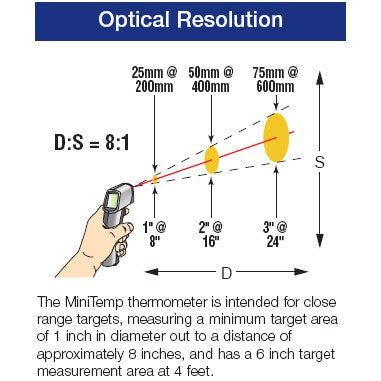
Distance to Spot Size:8:1
Typical Distance to Target (Spot): Up to 1.5m or 4 ft
Temperature Display: ºC or ºF selectable
Note:Using this infrared temperature gun can provide inconsistant result, depending on use. It is best to use this gun in conjunction with Lawson Thermo-Tel Temperature Tapes when checking for plastisol cure.
Technical FAQ: Choosing the Right Screen Printing Mesh Count
What mesh count is best for printing glitter and shimmer inks?
Use a low mesh count between 24 and 86 for glitter and shimmer inks. Larger glitter flakes require very open meshes such as 24/25, 38/40, or 60/61 to allow particles to pass through without clogging. For finer shimmer inks or foil adhesives, an 85/86 mesh provides better control while still allowing adequate ink flow.
Why is 110 mesh commonly used in garment screen printing?
A 110 mesh count is widely used because it delivers a heavy ink deposit, making it ideal for bold graphics, block text, and high-viscosity plastisol inks. It is especially effective for white underbases, allowing printers to achieve strong opacity in a single pass and improve production efficiency.
What mesh count should I use for thick white plastisol ink?
A 125 mesh count is a strong choice for thick white plastisol inks. It balances ink flow and detail, offering slightly finer resolution than 110 mesh while still maintaining enough openness to prevent clogging or poor ink release.
What is the best all-purpose mesh count for t-shirt printing?
A 156/160 mesh count is considered the best general-purpose option for screen printing on garments. It works well with both plastisol and water-based inks, providing good detail retention while maintaining consistent ink coverage across most designs.
How can I achieve a soft-hand feel when printing with plastisol ink?
To create a softer print with plastisol ink, use a higher mesh count such as 196/200. This reduces the amount of ink deposited on the garment, resulting in a lighter, smoother feel. Keep in mind that higher mesh counts may reduce opacity, making this approach best for lighter fabrics or fashion prints.
What mesh count is ideal for halftones and fine detail printing?
A 230 mesh count is ideal for halftones, fine lines, and detailed artwork. It allows for precise stencil definition and clean ink transfer. For very fine detail or thinner inks, a 280 mesh count can further improve sharpness and control.
When should I use a 305 mesh screen for screen printing?
A 305 mesh count is best for ultra-fine detail, including small halftone dots, CMYK process printing, and simulated process designs. The higher thread count ensures accurate dot reproduction and prevents distortion, resulting in sharper, more professional prints.